

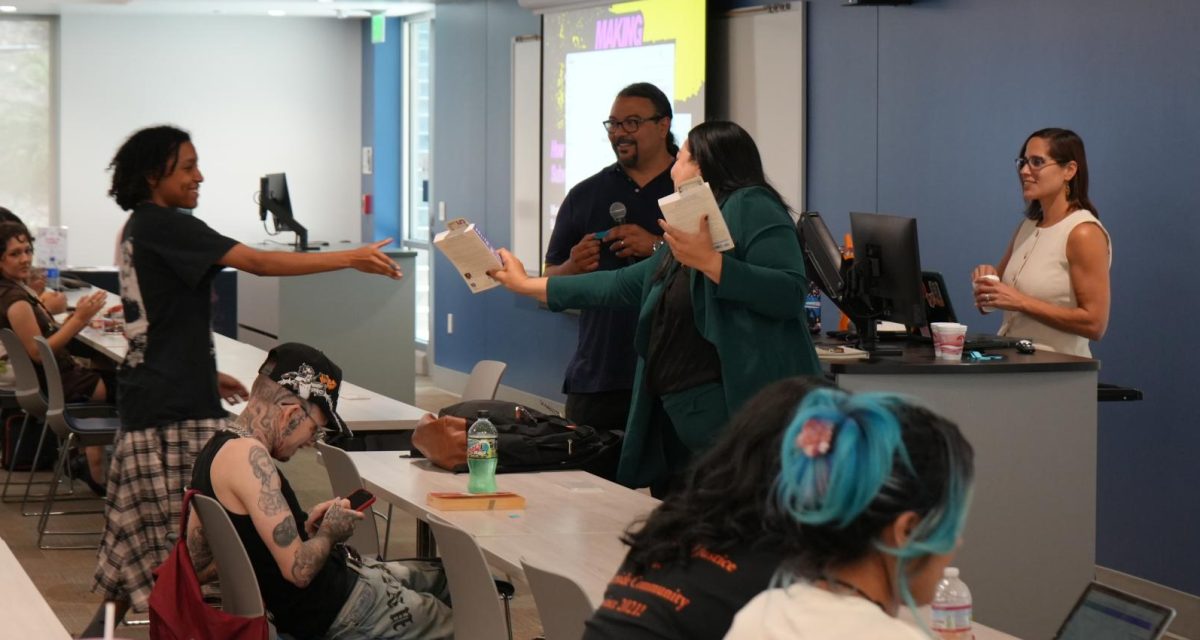
Several Riverside City College departments came together on May 7 to address oppressive narratives in the Latine community during a conference titled “We Are Here Because You Were There” held at the CIS Building.
The ethnic studies, La Casa, political science faculty, and Languages, Humanities, and Social Sciences all gathered to discuss these issues over pan dulce and snacks.
Instructor Citlalli Anahuac credited Laura Gomez, author of the book “Inventing Latinos,” for the conference’s name.
“Colonialism and immigration are part of the same continuum,” Anahuac said, reading an excerpt from the book. “We are here because you were there.”
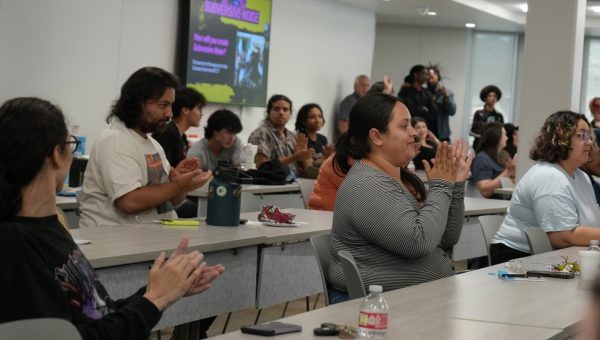
Instructor Raul Moreno represented the Salvadoran community. He shared his experience growing up in El Salvador during the 1980 Civil War and how that experience offered a blueprint for migration trends.
“We do not need to look very far, both in history or geographically, to find a reference point that can illustrate for us the dynamics that are played out today,” Moreno said.
Moreno steered the conversation from casual and innocent upbringings to a serious tone, discussing history and immigration.
Moreno played a recording of the poem by Carolyn Forché titled “What You Have Heard is True.” He felt this poem captured the political violence in the country’s early years of war.
The room was quiet as Moreno concluded the recording, which described how upset the colonel was about the resistance and how he would make the Salvadoran people suffer.
Part of the poem described how the colonel lived a well-off lifestyle. Yet, as Moreno explained, the origins of the war stemmed from widespread poverty, revealing the patterns of the wealthy few and the majority poor. The war resulted in 100,000 people dead and about 25% of the Salvadoran population displaced.
Salvadorans migrated across the Western Hemisphere and Europe, with a majority going to the United States.
Prior to 1980, there were 90,000 Salvadorans in the U.S. That number climbed to 1.2 million after the war ended in 1992. Today, there are 2.5 million Salvadorans calling the U.S. home, making them the 3rd-largest Latine group by nationality according to Moreno.
Moreno asked the audience, “What caused this uptick?”
Moreno said U.S. military intervention in domestic affairs since the 1890s and free trade agreements such as the North American Free Trade Agreement are to blame. The issue is more complex and Moreno pointed to statistics. He asked why today’s migratory trends match those in the past.
“People don’t migrate, they flee,” Moreno said.
Moreno said the U.S. denied asylum cases and stated, “This is how you end up with an undocumented problem.”
Miguel Flores, an RCC student, said the event helped him connect with the Latine community because he was born in the U.S., and he hadn’t had the opportunity before.
Flores mentioned he was shocked at the number of Salvadorian lives lost during the war and that it is good to hear the ugly truth of the Americas to prevent hindsight bias, stating, “Before I walked in here, I hadn’t heard about that part yet. That was actually pretty surprising, especially since it happened so recently.”


