

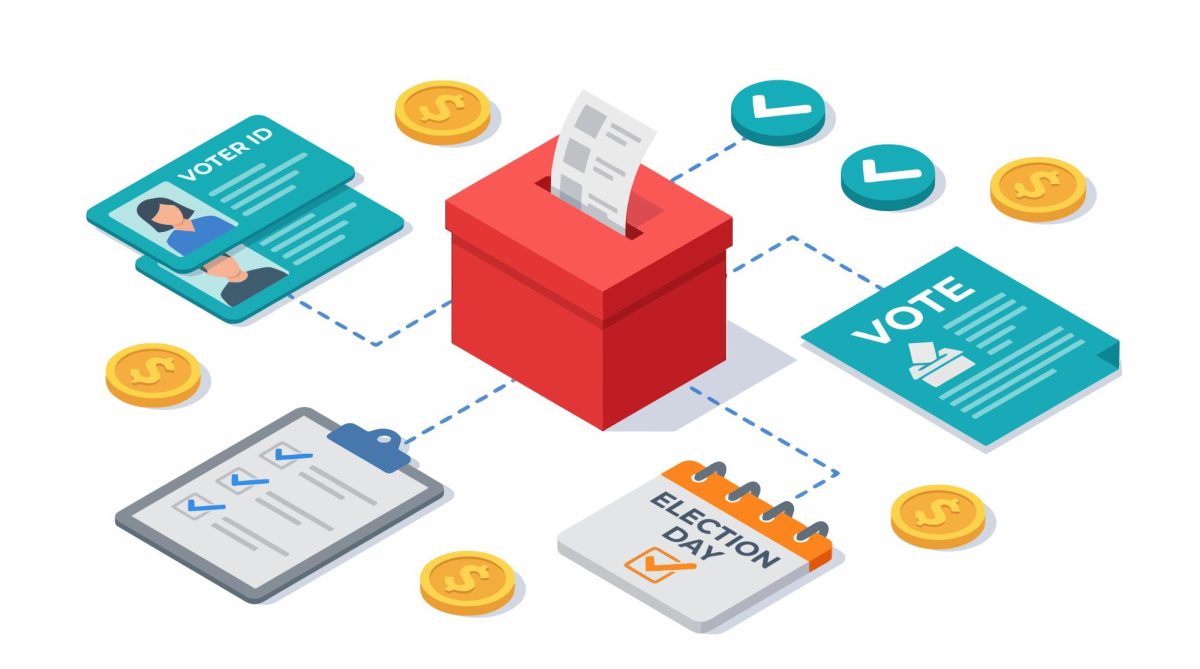
Republican leaders announced they reached the Voter Identification Initiative threshold for approval on March 3 and will place it on the Midterm ballots.
After more than five months of collecting signatures throughout the state of California, State Assemblyman Carl DeMaio (R-San Diego) and State Senator Tony Strickland (R-Huntington Beach), as well as the organization “Reform California,” have obtained the necessary 800,000 signatures needed for the Voter Identification Initiative, also known as Voter ID, to be put on the ballot this upcoming November.
DeMaio and Strickland, alongside Representative Ken Calvert (R-Corona) and Assemblywoman Leticia Castillo (R-Home Gardens), held a rally on March 3 outside of the Riverside County Registrar of Voters in Moreno Valley.
At the rally, DeMaio announced that the initiative had obtained more than 1.3 million signatures for the initiative to be put on the ballot, with 130,000 signatures from Riverside County alone.
The current state law requires that when registering to vote, individuals must state that they are United States citizens, provide information to verify their identity, such as their birthdate, driver’s license or Social Security number, not serving a state or federal prison term for a felony conviction and not be found mentally incompetent to vote by a court.
If the initiative is passed in the general election this November, it would amend the California State Constitution to mandate that, starting in the 2028 election cycle, “voters [will need to] present government‑issued identification at polling places or provide the last four digits of a government‑issued ID number when voting by mail.”
It also mandates that “the state issues voter identification cards upon request; and [that] elections officials annually report the percentage of each county’s voters whose citizenship has been verified.”
Many figures have announced their support for the initiative, such as Rep. Young Kim (R-Anaheim Hills), First Assistant U.S. Attorney and former Assemblyman Bill Essayli, and Assemblywoman Alexandra Macedo (R-Tulare).
Other supporters of the initiative include gubernatorial candidates Riverside County Sheriff Chad Bianco (R-Riverside), political commentator Steve Hilton (R-Silicon Valley), and Leo Zacky (R-Los Angeles), former vice president of Zacky Farms.
“The polling overwhelmingly shows a supermajority consensus for Voter ID requirements. A majority of Democrats [and] a supermajority of Independents and Republicans support Voter ID, it’s common sense,” DeMaio said. “It took a whole bunch of people from a lot of different walks of life, every skin color, every race, every religion, every gender, every orientation, and yes, every political affiliation.”
Opponents of the initiative have argued that voter fraud in elections is a very rare case. Jenny Farrell, the executive director of the League of Women Voters of California (LWV), argues that strict Voter ID laws can disproportionately impact low-income voters, seniors, people with disabilities and women whose identification may not match their voter registration due to name changes after marriage or divorce, as well as arguing that existing safeguards already protect against fraud.
The LWV released a statement on March 2 announcing the formation of a new coalition built on defeating the Voter ID Initiative, which would include the organizations of the ACLU Northern California, ACLU Southern California, LWV of California, California Common Cause, Asian Law Caucus, California Donor Table and Disability Rights California.
In the statement, the coalition claims that if the initiative were to pass, a large majority of California’s voter bloc who choose to vote by mail would be required to “write the last four digits of a government-issued ID number on the outside of their mail ballot envelope.”
“Those digits would pass through many hands and then sit in election records for almost two years, creating real exposure for identity theft for millions of voters, [and that] a simple fixable error like a wrong digit, or forgetting to include the ID, could cause someone’s ballot to be disqualified.”
In addition to the Voter ID Initiative, there is also the piece of legislation known as the Safeguard American Voter Eligibility Act, better known as the SAVE Act, which is currently pending in the United States Senate.
The legislation passed in the U.S. House of Representatives in April 2025 by a vote of 220-208, of whom Rep. Mark Takano (D-Riverside) of California’s 39th Congressional District voted no on the bill, while Reps. Calvert and Kim voted yes.
The legislation was started discussion by the U.S. Senate on March 18 and it would require individuals registering to vote to possess “documentary proof of U.S. citizenship.”
Both Riverside County and the state of California could see some form of Voter ID implemented in the county’s election process, but what remains to be seen is whether it would be in the 2026 or 2028 election.


